
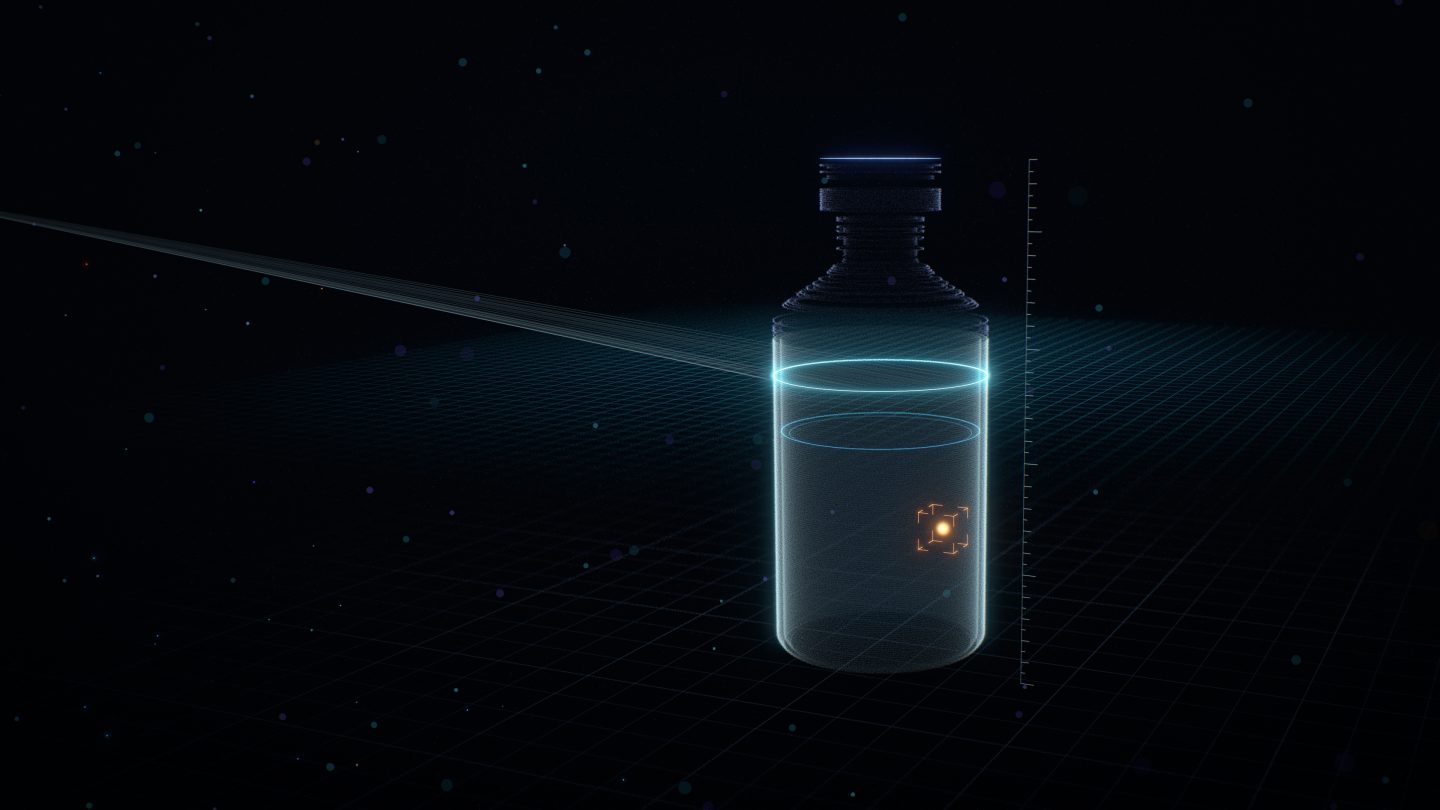
There is a sentence I often repeat to people who are new to industrial vision: the camera does not see the product, it sees the light that the product sends back. It sounds obvious. It is also the reason why so many promising computer vision projects struggle when they leave the lab.
The physics comes first
Glass reflects and refracts. Liquids move, foam and carry bubbles that look exactly like particles. Plastic films create glare, printed codes curve around bottles, and metallic surfaces turn every scratch into a bright line. No amount of training data can compensate for an image that does not contain the information you need.
The first design decision in a vision system is therefore not the model. It is the combination of optics, illumination, geometry and timing that makes the relevant features visible and the irrelevant ones disappear.
This is where a background in imaging research helps. In medical imaging you learn early that every acquisition is a trade-off between resolution, noise, time and the question you want to answer. The same reasoning applies to a camera looking at a vial at line speed.
Robustness is designed, not hoped for
A vision system lives in a changing environment. Lamps age, temperatures change, mechanical parts wear, products vary within tolerance. Reliability comes from treating these variations as first-class requirements: measuring them, reproducing them in tests, and choosing methods — classical or deep learning — that degrade gracefully instead of failing silently.
Deep learning has transformed what is possible, especially where defects are subtle and variable. It does not remove the need for engineering judgement. Often the best solution combines both: careful acquisition and deterministic measurement where physics is predictable, learned models where appearance is too complex to describe with rules.
Validation is part of the product
In regulated industries, a system is only as good as the evidence that it works. That means datasets that represent real variability, test protocols that can be repeated, metrics that reflect real risk, and documentation that someone else can audit. Designing for validation from day one changes many choices: which data to keep, how to version models, how to log decisions.
Time is a constraint, not a detail
A line does not wait. Every image has a budget of milliseconds that includes acquisition, transfer, pre-processing, inference and the decision sent back to the machine. The architecture — what runs on the camera, what runs on a GPU, what is written in C++ and what in Python — follows directly from that budget. Getting it right early saves months later.
Reliability is the feature
Customers rarely ask for “a neural network”. They ask for fewer escapes, fewer false rejects, less manual inspection, and traceability they can trust. Reliability is the feature they are buying. The engineer's job is to make it measurable — and then to make it true.